 WeWed
52 Questions That Get Couples Talking Again
You talked today. Schedules, dinner, whose turn it was for pickup, what to watch tonight. You talked a lot. But here is the question worth sitting with: when was the last time you and your partner had a conversation that was not about logistics?
If you had to think about it, you are not alone. Most couples are not short on talking — they are short on the kind of talking that makes you feel known again.
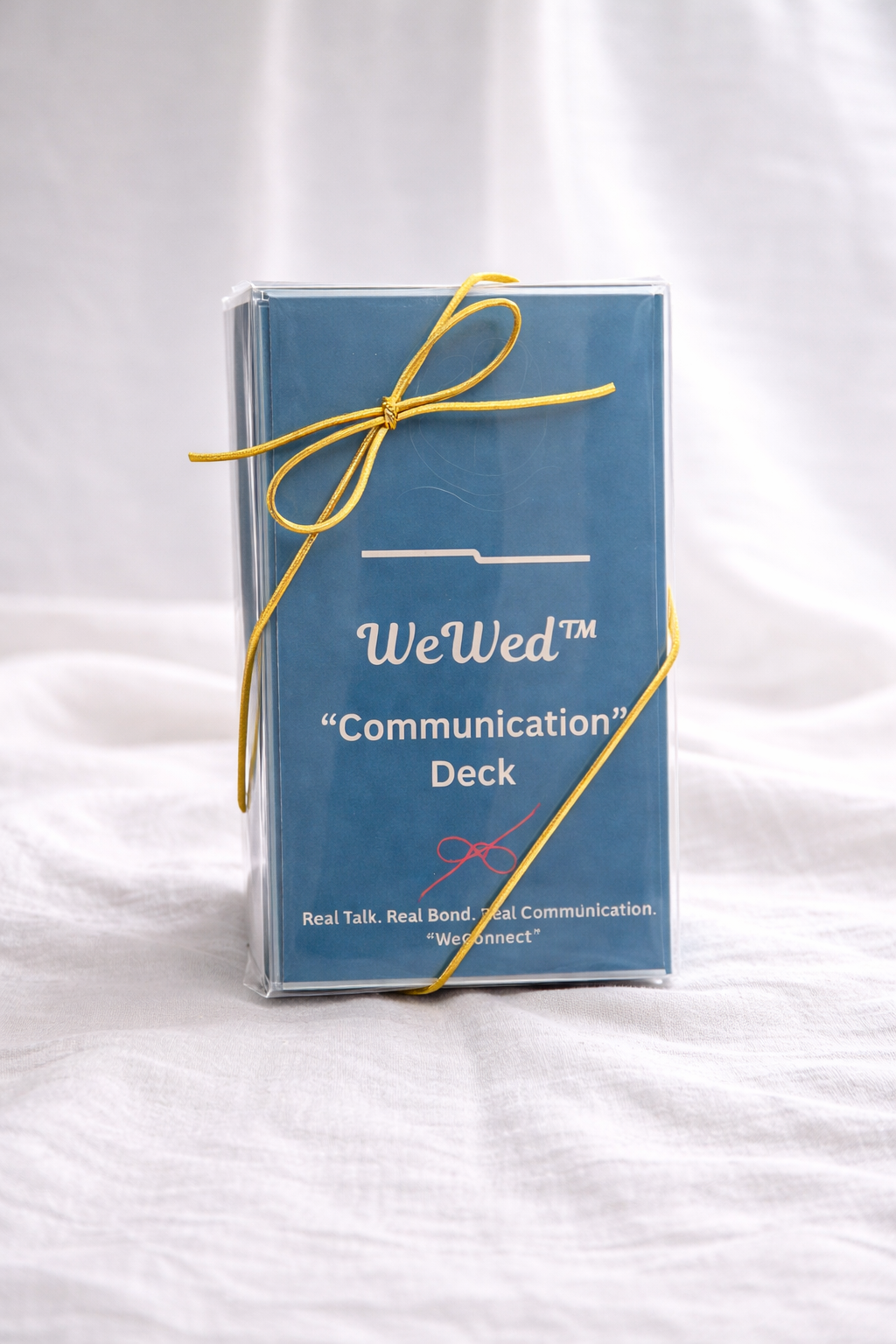
That gap is exactly why we built the WeWed Communication Deck. Not as a game to win, but as 52 questions that make real conversation easy to start.
Why couples stop really talking
It rarely happens dramatically. Nobody decides to stop sharing their inner world with the person they love most.
It happens in seasons. Busy seasons. Stressed seasons. The season with a newborn, or a new job, or a parent in the hospital. Conversations shrink to coordination — who, what, when — and the deeper questions quietly go unasked.
The tricky part: most couples genuinely want to go deeper. They just do not know how to open the door without it feeling forced, or like the start of an argument.
So the questions stay unasked. And the distance grows a little at a time.
Most couples are not short on talking. They are short on the kind of talking that makes you feel known again.
What conversation cards actually do
Here is what a deck of conversation questions does that willpower usually cannot: it removes the pressure of inventing the right question in the moment.
Instead of one of you working up the nerve to say “can we talk about something real?” — you draw a card. The card asks. You answer. Nobody had to be brave enough to start.
A good question does three things a normal Tuesday conversation does not:
- It goes somewhere you would not have gone on your own
- It gives both people equal airtime
- It makes listening the whole activity, not a pause before your turn
That is why structured questions are a staple in counseling and coaching work. The structure is not a crutch — it is what makes depth repeatable.
Inside the WeWed Communication Deck
The deck holds 52 questions — one per card — written to move a conversation past small talk and into the territory where connection actually lives: how you feel, what you need, what you are afraid of, what you miss, what you hope for.
The questions work whether you have been together six months or twenty-six years. Some cards are light and fun. Some go deeper. You choose the pace — and you can stop anywhere, anytime.
One sample card: “What’s one thing about you I might still not fully get?”
That is the flavor. Not interrogation. Invitation.
7 ways couples can use the deck
This is the part people wonder about most: when do we actually do this? The honest answer is — anywhere you are already together. A few patterns that work well:
1. Date night at home
Swap the third episode for three cards. If you want ideas for the evening around it, we wrote a whole guide to intentional date nights at home.
2. The weekly check-in
One card, once a week, Sunday coffee or Thursday after dinner. Small and repeatable beats big and rare.
3. In the car
Long drive, no screens, one card at a rest stop. Some of the best conversations happen when nobody has to make eye contact.
4. Reconnecting after a rough patch
When things have been tense, starting a deep conversation from scratch can feel loaded. A card makes it neutral — the deck asked, not you.
5. Engaged and preparing
If you are heading toward marriage, our premarital conversation starters cover the big practical topics. The deck covers the personal ones — and couples often use both.
6. Playing with other couples
Double date, one card per couple, compare answers. It is surprising how much you can learn about your own relationship by hearing someone else’s.
7. Just because
No occasion needed. The deck lives on the coffee table, and a card gets pulled whenever the evening needs a place to start.

How to make a card conversation go well
The cards start the conversation. These five habits keep it good:
- Put phones in another room. Not face-down. Another room.
- Take full turns. One person answers completely before the other starts.
- Listen to understand, not to reply.
- Do not turn answers into evidence. A card conversation is not the place to raise old grievances.
- It is fine to pass. A skipped card is better than a forced answer.
And if a conversation opens something bigger than an evening can hold — that is not failure, that is information. Pausing is allowed. Getting support is allowed too.
Who the deck is for
Couples at every stage — dating, engaged, newly married, long-married, rebuilding. It is also designed to work well for therapists, coaches, and counselors who want a ready-made set of conversation prompts for the couples they serve.
And it is a quietly perfect gift. For the couple who has everything. For the friends who just got engaged. For your own marriage, as the thing that finally gets pulled off the shelf on a random Wednesday. (And if the women in your life deserve their own kind of deep conversation, the WeWed Sisterhood Deck does for friendship what this deck does for couples.)
Ready to start the conversation?
The WeWed Communication Deck is $25 — 52 questions, built to be used again and again, because connection is not a one-time project. It is maintenance. It is a practice.
Get the WeWed Communication Deck
If you would rather talk things through with a person first, Coach Lovey works with individuals and couples — you can explore WeWed’s coaching services or reach out whenever you are ready.
Frequently Asked Questions
Do we have to use the whole deck at once?
No — and you should not. One to three cards per sitting is the sweet spot. The deck is designed to come back to, not to be finished.
What if a question brings up something hard?
Pause. That is allowed and normal. Some of the best conversations need more than one night. If something keeps feeling stuck, support from a coach can help you move through it.
Is this only for couples in trouble?
Not at all. Strong couples use it to stay strong. The best time to build connection habits is before you need them.
Is it good for newlyweds or long-married couples?
Both. The questions work at any stage because they are about who you are now — and that person keeps changing.